Showing posts with label osce. Show all posts

Friday, November 19, 2010

Serenity now

There comes a time before each exam when you must find the balance between learning and de-stressing.  For me, that time is now.  And the balance is learning 0%, de-stressing 100%.

This is particularly true of studying medicine because there seems to be no limit to what we might reasonably be expected to know, even though in actuality what we are expected to know is quite reasonable and sensible.  In fact, to put it in the words of an Esteemed Colleague, "They just want us to be sub-lethal".  Just make sure you know Plummer-Vinson (Paterson-Brown-Kelly) Syndrome back to front.  Sure, it's rookie stuff, but you'll look silly if you haven't reviewed it.

Everybody de-stresses in different ways.  Some people hit the gym.  Some people meditate.  I like to behave like an effete retired dilettante.  So here's what I do:
  • Feed the birds.  Tut-tut over the crows that have been pushing the rosellas around.
  • Put some string quartets by Mozart on the stereo.
  • Slowly nibble some avocado and smoked salmon on whole-grain ano-bread while sipping my eco-coffee and browsing The Guardian online.  Tut-tut over government spending cuts in the UK.
  • Gaze vacantly out the window at the garden, thinking about where I might plant some bulbs for the winter.
  • Put some waltzes by Chopin on the stereo.
  • Go to my blog and dispense some patronizing and sanctimonious advice to my long-sufferering readers.
  • Do some tai-chi in the front yard where the neighbours will be sure to see me.
  • Throw open all the windows in the house and stand in front of them with hands on hips breathing deeply and saying, "Aaah, it's a beautiful day!  Feel the air in your lungs!"
  • Put some Bach violin sonatas on the stereo.
  • Idly wonder what might be on the OSCE tomorrow.
  • Hurriedly snatch up an excrutiatingly detailed textbook and attempt to memorize specific gene defects for a range of rare diseases for the best part of an hour before collapsing sobbing into a corner.
  • Put some Rachmaninoff piano concertos on the stereo.
  • Tell everybody on Facebook how bored I am.  Tut-tut over the young folk these days.
The next time you have a big exam looming, why not try my method?  It's never failed me!

Friday, October 29, 2010

The OSCE is like a dose of clap

In a few weeks I'll be sitting our final OSCE (a practical exam).  There will be twenty stations, each of five minutes.  Because there are more than twenty people in my class, we're divided into in four groups: a morning and afternoon session each of which has two parallel "streams" running at the same time with the same stations.

Yesterday we got the email allocating us to our spot in this big chaotic event.  I am not pleased that I am in the "yellow" stream.  This immediately made me think of Whistler telling the Prince Of Wales that he was like a stream of bat's piss in the Monty Python sketch about Oscar Wilde.  That's not really the image I need to get me psyched up.

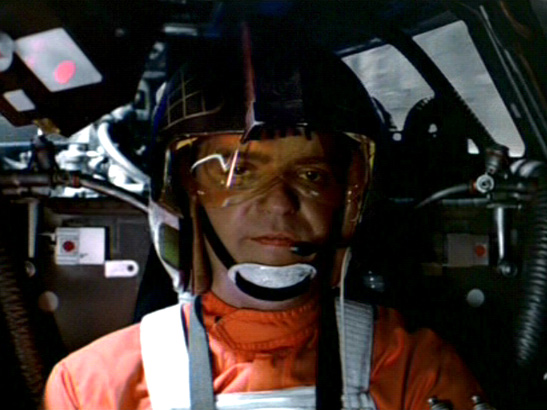
So I'm going to think of it as the gold stream.  When the rebels attacked the Death Star, did they have a yellow squadron?  No, they had a gold squadron.  Red, blue, gold, green.  Much better.

Actually, since I am listed first on the list of stations, I think of myself as Gold Leader.  A quick check on Wookiepedia shows that this makes me Jon "Dutch" Vander.

Which is nice, sure, but there are a few problems with it.  First, Gold Squadron was flying Y-wings, not X-wings.  Y-wings are pretty gumby starfighters if you want my opinion.  X-wings are where it's at.  The Y-wing is to the X-wing as C-3PO is to R2-D2.  And second, Dutch was shot down and killed by Darth Vader after he panicked during the trench run on the Death Star exhaust port.  Not a good omen for my OSCE outcome. Hopefully none of the OSCE stations will involve exhaust ports.

Still, at least I stood up for what is right and sacrificed myself to help defeat the Empire.  Maybe I'll get bonus empathy marks to make up for my lack of galactic competence.

Tuesday, October 5, 2010

OSCE stations for the real world

Having recently undergone trial-by-OSCE, it concerns me that the stations were extremely unrealistic.  Oh sure - they may well be very similar to the stations we'll get at the end of the year.  But they bear absolutely no similarity to the tasks that medical students are required to undertake every day and thus they are a poor measure of medical student core competencies.  Here are some model stations I've come up with to make the OSCE fairer.

Obstetrics and Gynaecology
Student Instructions
You are in a pre-natal clinic doing routine checkups.  You haven't seen a birth all year and realize that this is your last chance to get on board.  Please convince the patient that they should boot the student midwife off the list and let you assist with the birth instead.

Standardized Patient Briefing
Do not agree to let the student be present at your birth even if they cry and beg.  It is important that you mention the following counter-arguments provided to you by the midwifery student:
  1. The doctor always misses the birth anyway then swans in with a muffin saying, "How are things going in here, ladies?"
  2. On the off chance the doctor doesn't miss the birth, he/she will want to do an unnecessary caesarian.
  3. Oh, and doctors are always pressuring you to agree to drugs that will give your baby autism.
As the student leaves the station, let him/her know that you would have agreed if he/she was more experienced.


Surgery
Student Instructions
You are in clinic with Dr Bastard, a surgeon.  He instructs you to examine the patient's Ossicles of Zeno and give him your top ten differential diagnoses and the associated aetiologies.

Standardized Patient Briefing
The student will attempt to examine your Ossicles of Zeno whilst being glared at by Dr Bastard. Ensure that you ask the student the following questions as he does so:
  1. Is it true that they don't teach anatomy any more?
  2. If that's the case then where is my spleen?
  3. No, I'm sure the left is where the liver is.  My cousin has his liver removed when he was five, how long can you live without a liver?
  4. So you want to be just like Dr Bastard do you?

General Practice
Student Instructions
It is lunchtime.  You have been consulting with your supervisor all morning and feel that you are finally getting the hang of this stuff.  Enter the staff lunch room and converse with your supervisor.

Supervisor Briefing
The student will attempt to interact with you as if you are human.  Behave capriciously and imperiously.  Ensure that the following points are covered in your conversation:
  • Ask them where they have been all morning.
  • Introduce them to someone that you know they have met before.  Get the student's name wrong.  Be incredulous if they correct you.
  • Ask the student a question about themselves then start talking to someone else while they are answering you.
  • Reminisce fondly about previous students who were much more engaged, competent and intelligent.
  • Criticise the university and its terrible teaching and newfangled course that has resulted in such a poor student being sent to work with you.
  • Announce that a drug rep is turning up soon and throw the student out.

Paediatrics
Student Instructions
Please give the child in this room an injection.

Standardized Patient Briefing
Your child is to receive an injection.  Please follow these steps:
  • Instill fear in your child by getting very tense and promising them a huge reward afterward if they don't scream.
  • Instill distrust in your child by promising them that it won't hurt at all.
  • Overdress your child in multiple layers so that getting access to even a single limb is impossible without a struggle.
  • Wait until the child has spotted the needle and has started screaming before raising your concerns about the possible side-effects of the injection.
  • Restrain your struggling child until the needle is almost touching their skin.  Then release your child suddenly, allowing them to flail around wildly and maximise the chance of the student stabbing themselves with the needle.

Medicine
Student Instructions
You have been sent to buy lunch for a senior consultant.  You were told to go to "Jack's Cafe down the road to the right" and buy a tandoori chicken, avocado and edam sandwich on white bread, and a large soy macchiato.  You have discovered that Jack's Cafe has been closed for six years.  There was only one other cafe within a reasonable distance and it didn't have much to choose from.  You have returned with a bacon, pumpkin and cottage cheese flatbread wrap and a small latte.  Enter the room and give the consultant her lunch.

Consultant Briefing
Ensure that you raise the following issues with the student when he/she returns with your lunch:
  • They have been gone a long time and missed seeing lots of interesting signs in patients.
  • This is not the sandwich you wanted.
  • This is not the coffee you wanted.
  • Jack's Cafe was there last week.
  • This is not the sandwich you wanted.
Do not offer to reimburse the student for the cost of your lunch.  If they do ask for money you should remind them that this is not the sandwich you wanted.  If they still persist, point out to them that the university doesn't pay them very much for the teaching you provide.


Psychiatry
Student Instructions
Please observe the following conversation between doctor and patient for five minutes.  At the end of this time you will asked to diagnose each of them with a mental illness and/or personality disorder.

Examiner Marking Sheet
Bonus marks if the student also diagnoses themselves with depression.

Thursday, September 30, 2010

Expecto Patronisum

No.  No no no no no.


We had a practise OSCE this evening.  Oh how we laughed.  Eight stations, five minutes each.  All pretty straightforward stuff.  Or it would be, if you had any freaking idea what you were doing. 
Case in point: x-rays.  Now I know all about x-rays.  But clearly I don't know much about anatomy or pathology because I tanked that station.  Really badly.  But hey - that's why we have radiologists, right?  I mean, apart from having to find somewhere to put all the oddball graduates.

Anyway, that's not what this blob is about.  This blob is about the post-OCSE feedback session in which we were ruthlessly patronized by our supervising doctors who marked us.  Here's what went down...

First, we were subjected to a lengthy mealy-mouthed pep talk which actually contained nothing of substance whatsoever.  "The best advice for the OSCEs is to go into each station and genuinely try to address the clinical problem that is given to you."  Swerving that violently to avoid colliding with actual content left me reeling with mental whiplash and in no state for what was to follow.

We were then given a little finger wagging lecture about how if we are ever in the position of not knowing something we should always ask for a little lesson on it right then and there to "close the gap" rather than just shrugging and saying, "Meh, I can haz brains L8R", presumably because we are all adolescent dipshits rather than responsible adults.  At this point I bit my tongue and refrained from pointing out that, in my experience, asking questions of doctors leads to one of two possible answers:
  1. You should know this by now.
  2. It's not my job to answer questions that you can look up in a textbook.
Then, we were told in feedback for one of the stations that it was disappointing that so few of us knew the dose for drug X.  There were two marks available for knowing the drug and the dose but if you didn't know the dose you got zero.  Right. 

We did point out that we've been specifically told that we don't need to know the doses of drugs, to which the response was the evergreen and fanciful idea that we can get some kind of mythical "bonus marks" for impressing the examiner with knowledge like drug doses (as opposed to the cruel reality of disappointing your examiners by being unable to distinguish the bum from the elbow).  Buddy, the day I start spending my time planning ways to "impress" my examiners is the day I'm not devoting enough time to my stamp collecting.

Seizing the opportunity presented by our collective stunned silence in response to the feedback about the dose of drug X, I asked a question.  "Oh wise practitioners", I asked, "To enable me to close the gap and to ensure that I learn something from this encounter, couldst thou in thy wisdome inform me of the correct dose for drug X?" 

There was widespread hilarity.  My Esteemed Colleagues laughed because they know me well and recognized that I was being at least somewhat of a Smart-Arse.  The doctors laughed because I should know this by now and they are not here to answer questions that I could look up in a book.  I kid you not - the doctor next to me said, "You'll remember it better if you look that up yourself when you get home".  And then another doctor said, "The correct dose is one ampoule", and chuckled to himself behind his little doctor's beard.

I love it.

Friday, March 26, 2010

Mock OSCE

We had a mock OSCE on Wednesday night.  (An OSCE is a oral exam where you interact with either actors playing patients or real patients and you have to be the doctor.)  There were only five active stations and two rest stations, but the organisers had structured it so that it was excellent preparation for the real OSCE at the end of the year.  Here's an overview of what each station was testing.

Station 1: Panic
The first OSCE skill to master is panic.  If you go into your first station and you don't panic, the patient and the examiner will know that you are a clueless noob.  For this reason, getting a good panic on for the first station is essential.  Some things that may help are to drink too much coffee, imagine how your life will be wrecked unless you perform perfectly, and to glance at advanced textbooks immediately before the start of the OSCE to ensure that you are fully aware of how much you don't know.  If, despite your preparation, you find yourself unnaturally calm and relaxed, you could try hyperventilating to induce lightheadedness.  Alternatively, try bluffing your way through by moistening your palms and brow with water to give others the impression of fear.

Station 2: Disorganisation
This skill is most usefully displayed during a station which combines history taking and examination.  You should immediately commence examination, and if possible arrive at a firm diagnosis immediately.  This allows you to suggest management, preferably something which would be contraindicated by common conditions with similar presentations.  Thus, you then are compelled to ask a few history questions which then trigger something in your mind to test by examination, and thus the cycle begins again.  It would be good if, from time to time, you then leap back to history taking by asking some general systems questions.  The effect you're looking for is something like this: "The patient is tachycardic, it's almost certainly a pulmonary embolus, I'd recommend thrombolytics, oh wait, maybe it's blood loss, have you noticed any change in your bowel habits?  The abdomen is tender in the right iliac fossa, how are you sleeping?  And your parents, do they have any history of epilepsy?"

Station 3: Time mismanagement
After station 2 you will realize that you need to be more thorough.  Thus, station 3 is the one where you can delve step by step into the minutiae of the patient's condition.  With any luck, you'll still be only halfway through taking a history when the bell rings for the end of the station.  A good place to get bogged down is when asking about medications - few patients can remember the correct names and doses of their tablets, so this gives you the opportunity to spend a long time trying to pin them down.  "Are you sure it was atenolol?  Not metoprolol?  Or nebivolol?  Or carvedilol?  What colour is the tablet?"  Alternatively, a good chunk of time can be burned up by an inquisitorial style when asking about smoking and alcohol.  Believe nothing that the patient tells you and scold them for not telling you the truth.  With luck you'll not only waste time but antagonise them so much that the rest of the station is complete disaster.

Station 4: Compensatory euphoria
By this stage of the OSCE you're past the halfway mark.  Soon it will all be over, so it's traditional at this point to relax a little and lapse into compensatory euphoria.  Thus, the fourth station is there to test your ability to urge the patient to make sweeping lifestyle changes while assuring them how great the results will be with just a little willpower, and babble at great length in order to show the examiner how wonderful your interpersonal skills are. A useful technique is enthusiastically agree with everything the patient says and then continue talking as if they hadn't said anything.  Another good trick is to dump on the patient all of the detailed pathophysiology that you learned in first and second year.  This will baffle them into stunned silence and ensure you have maximum talking time.  Again, hyperventilating while reading the instructions on the door before you enter the station can be invaluable in getting you into the right frame of mind!

Station 5: Exhausted confusion
This is one of the easiest OSCE skills to master once you know the right approach.  The key step is to begin preparing early on.  Don't eat anything since the night before.  Sleep badly.  If you have any notepaper to write on, keep notes for all stations on the same piece of paper.  Make sure you don't write any names or other identifying material.  This will allow you to keep asking, "What's your name again?", and, "I know I've asked you this before, but where is the pain?"  Hopefully you will have performed terribly on each of the previous stations so you'll be tired, demoralized and sick to death of the whole thing.  Sigh deeply.  Stare down at your notes and shake your head.  From time to time, glance despairingly at the examiner as if begging for help.  If you are unfortunate enough to have to recommend management, try being unable to recall the names of drugs, or unable to pronounce them properly.

So that's how you do a mock OSCE!  If you practise these skills at every opportunity, you'll be ready to savour the full richness of the real OSCE at the end of the year.  Of course it's hard to extrapolate from just 5 stations to the full 20, but keep in mind that these techniques can be used not only in isolation but in combination.  When you're first starting out it's advisable to master them one by one.  By November, however, I expect you'll be able to use these notes to play a beautiful symphony of underperformance in the key of F.

I just wanted to say good luck, and we're all counting on you.